Hospital and healthcare ice machines support patient hydration, nutrition service, staff areas and sometimes clinical workflows. That makes equipment selection less about choosing a preferred ice texture and more about controlling access, cleaning the dispensing path and maintaining dependable production across every shift.
Nugget ice is often selected because it is soft, chewable and useful in beverage and patient-care settings. The machine still has to fit the facility’s infection-prevention policies, water-quality program and maintenance resources. Freezer Supply’s overview of commercial ice machines is a useful starting point for comparing undercounter, modular and dispenser configurations.
Map every healthcare use point
Begin with a count of beds, meals, staff shifts and public or departmental service points. Then document whether ice is dispensed into covered cups, used by dietary staff, available in a waiting area or transported from a central room. A single pounds-per-bed allowance rarely captures all of those uses.
Peak timing matters. Morning nutrition rounds, therapy schedules and shift changes can create a short draw that is much heavier than the daily average suggests. Storage and recovery should support that period without encouraging staff to handle ice manually or carry uncovered containers long distances.
Choose dispensing before choosing capacity
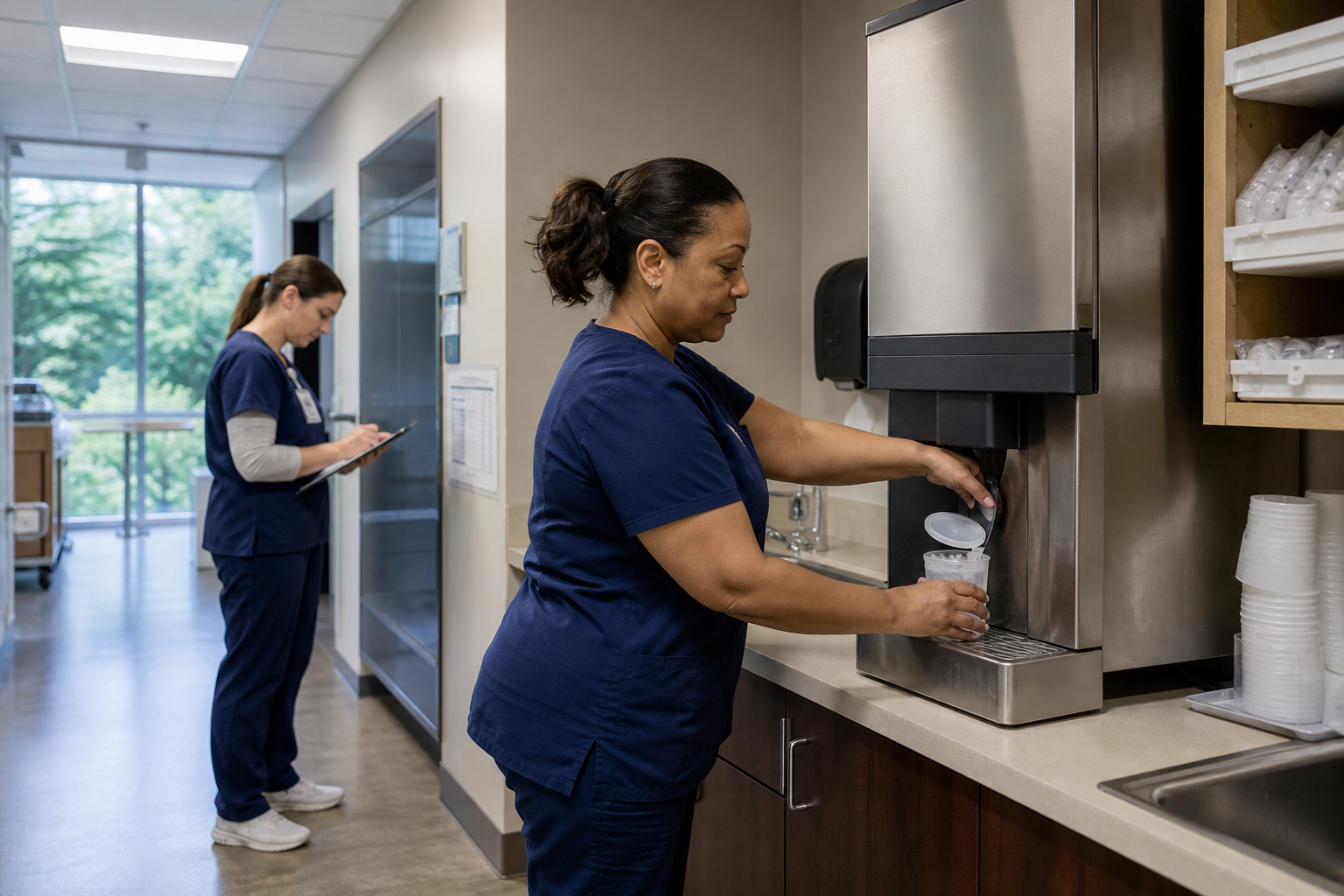
Open bins may be familiar in foodservice, but many healthcare facilities prefer enclosed ice-and-water dispensers that limit hand contact and simplify portioning. Touchless or lever-operated dispensing can reduce contact points when it fits the facility’s cleaning protocol. The equipment must also be accessible to the people expected to use it.
Specify cup clearance, dispenser height, drain arrangement, splash control and the amount of ice held in the dispensing hopper. Nugget machines require regular cleaning of the ice-making and dispensing components; a feature marketed as sanitary does not replace a documented cleaning process.
A representative Atlanta rehabilitation facility
Consider an anonymous rehabilitation facility evaluating replacement equipment in metro Atlanta. This representative planning example is not presented as a named Freezer Supply customer installation. The building had one central open-bin machine, and staff carried ice to two therapy areas and a patient nutrition station.
The facility initially considered a larger replacement at the same location. After observing the actual workflow, the team found that transport and open handling created more operational risk than production capacity. It evaluated two enclosed nugget ice-and-water dispensers placed near separate demand centers, each with accessible service clearance and a dedicated cleaning schedule.
The two-unit approach reduced travel and maintained limited service if one dispenser was being cleaned. It also required two drains, two filters and more routine maintenance, so the decision was based on workflow rather than a claim that duplication is always better. A facility comparing commercial ice machines in Atlanta should make the same location-by-location assessment. Buyers elsewhere can review Freezer Supply’s broader Georgia commercial ice machine coverage.
Account for water quality and cleaning labor
Water filtration should be chosen from a current water analysis and the equipment manufacturer’s requirements. Sediment, scale and disinfectant characteristics can affect performance, flavor and maintenance. Filters also need enough capacity for the expected production rate and a replacement schedule that the facility can follow.
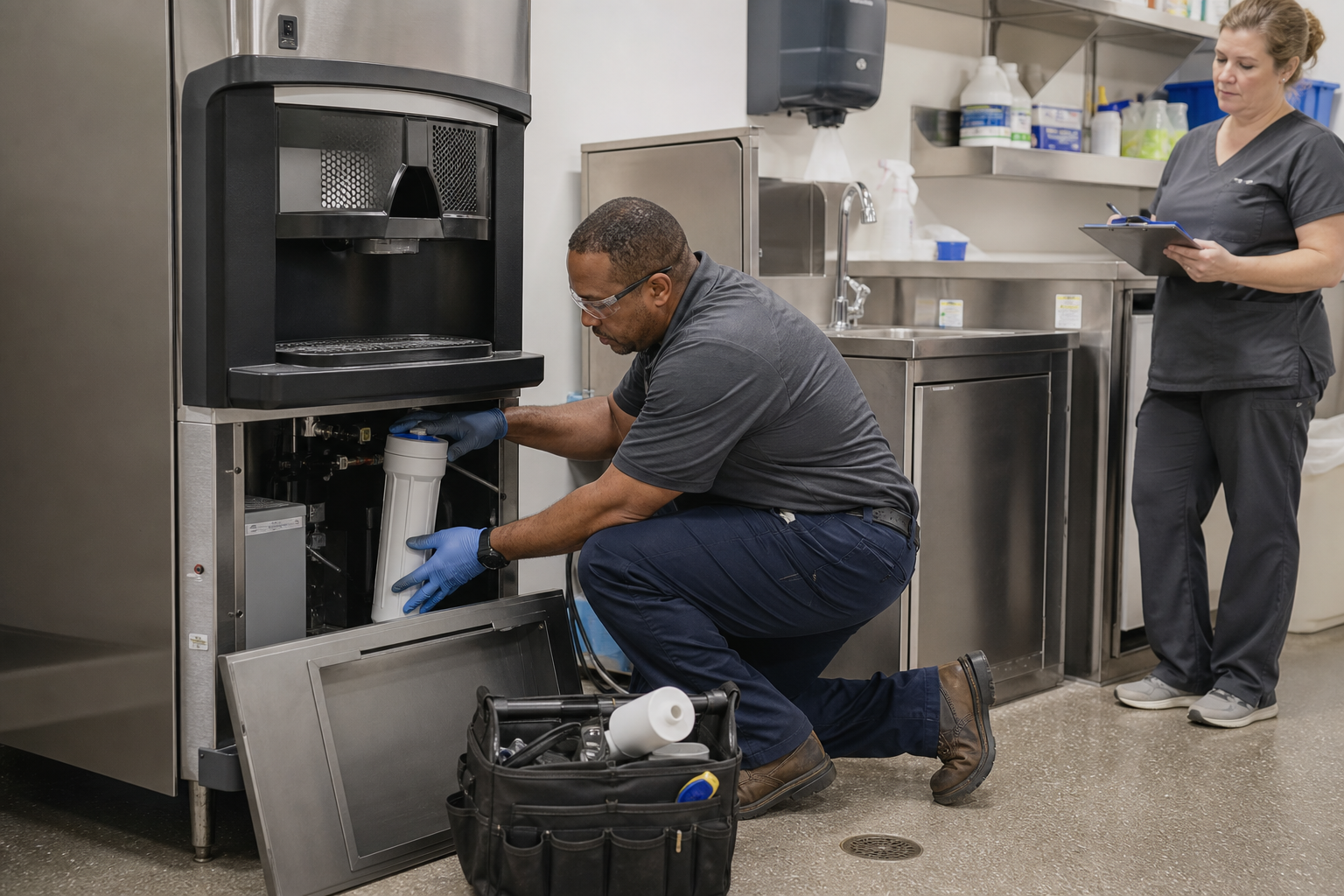
Ask who owns the cleaning task, what training is required and how the machine will be taken out of service. The dispensing chute, drain pan, hopper and internal food-zone components need reachable surfaces. Our guidance on preventing mold and slime in commercial ice machines explains why visible wiping is only one part of a complete program.
Plan utilities and service access
Confirm potable water, backflow requirements, drain type and elevation, electrical service, ventilation and equipment clearances. A dispenser recessed tightly between cabinets may look finished but become difficult to clean or repair. Leave room to remove panels and filters without blocking a patient corridor.
Heat rejection also matters in small alcoves. Air-cooled equipment needs the manufacturer’s clearances and a room that can handle the rejected heat. Remote or water-cooled options may solve one constraint while adding installation complexity elsewhere.
Build a dependable procurement specification
Include the number and type of users, peak dispensing period, preferred ice form, cup size, accessibility needs, daily production, internal storage, filtration, cleaning responsibility, utility conditions and the consequence of downtime. Use the commercial ice machine pricing form when those inputs are ready.
Frequently asked questions
Why do healthcare facilities use nugget ice?
Nugget ice is soft and useful for beverages and hydration service. Suitability for a specific patient or clinical use remains a facility decision governed by its care and safety policies.
Is an enclosed dispenser better than an open bin?
An enclosed dispenser can reduce manual contact and control portions, but it still needs frequent cleaning, correct drainage and disciplined maintenance.
How should a hospital size an ice machine?
Count all demand centers and measure the busiest service period. Production, internal storage and recovery should support peak use at expected room and water conditions.
Should healthcare facilities use one central machine or several smaller units?
Central equipment can simplify maintenance, while distributed units reduce transport and may improve redundancy. The right arrangement follows the building workflow, staffing and utility access.