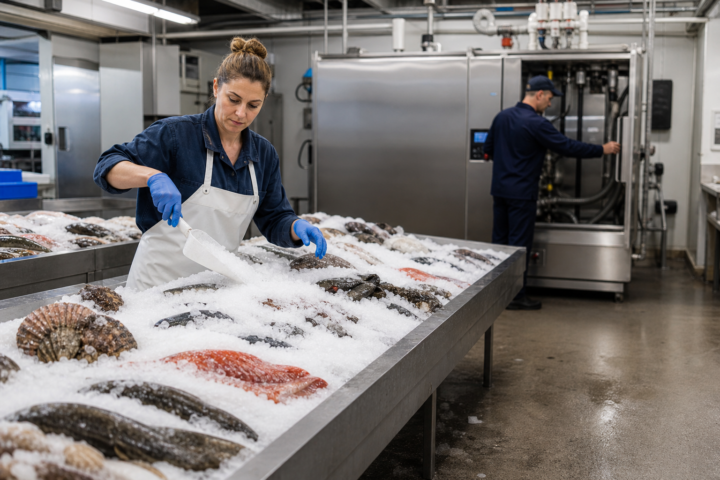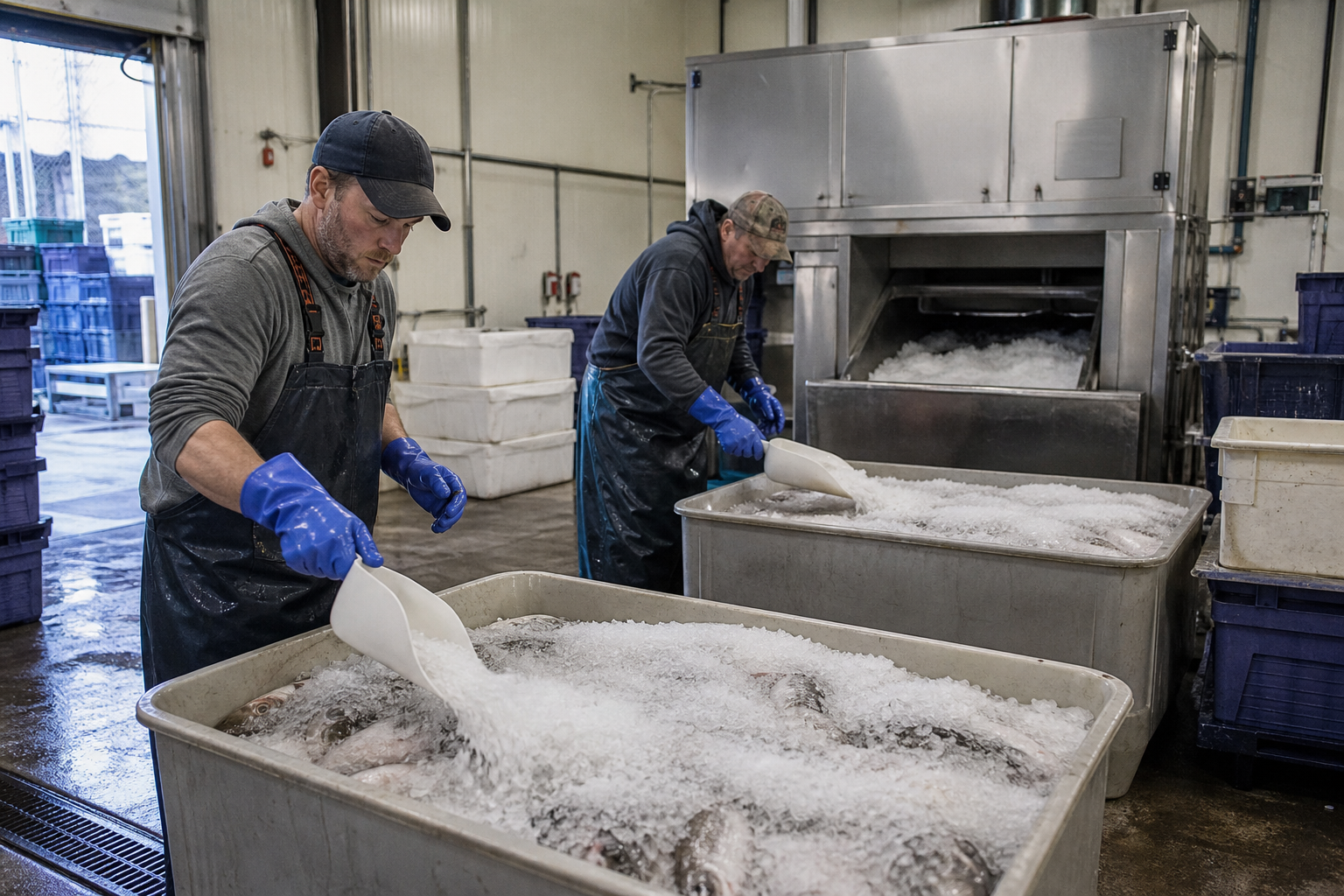
For a seafood market or distributor, ice is part of the cold chain. The machine has to produce the right form of ice, recover after heavy receiving periods and deliver it where employees can use it without slowing down packing. A unit that looks large enough on a brochure can still fall short when several inbound loads arrive before lunch.
Flake ice is often the practical choice because its thin, irregular pieces spread across whole fish and packed seafood without leaving large air gaps. It conforms around the product, presents well in a display and moves through bins and carts more easily than hard cubes. Buyers comparing commercial ice machines for seafood operations should still evaluate the complete handling system, not just the evaporator.
Start with pounds of product, not machine size
Document how many pounds of seafood arrive on a peak day, how much ice is used in each tote or display and how often employees replenish it. Separate receiving demand from display, packing and outbound shipping demand. Those uses may overlap for only a few hours, but that overlap usually determines the real production requirement.
Production ratings are also affected by incoming-water and ambient-air conditions. A machine installed near a warm loading area may not deliver its favorable published rating during a coastal summer. Use the expected site conditions and add a measured operating reserve; do not simply add an arbitrary percentage to an uncertain estimate. Our commercial ice machine sizing guide explains how peak demand, recovery and bin capacity work together.
Why seafood operations usually prefer flake ice
Flake ice offers broad surface contact, distributes easily and can be packed around irregular product. It is soft enough for handling and display work, yet it still requires proper drainage so meltwater does not pool around the product. The right choice depends on the seafood, the length of holding time and the facility’s food-safety plan.
Do not treat every flaker as interchangeable. Compare production at design conditions, ice temperature and moisture, storage compatibility, condenser arrangement, cleanability and access to service parts. The machine head, bin, rake or agitator and delivery method need to function as one system.

A representative Charleston seafood distributor
Consider an anonymous, representative distributor serving restaurants and markets near the coast. This is a planning example based on common conditions, not a named Freezer Supply customer installation. The operation received product early, packed orders through midday and replenished a retail counter in the afternoon. Its original plan called for one large flake machine feeding a central bin.
When the team mapped demand by hour, the main problem was not average daily consumption. Receiving and outbound packing overlapped, and a single cleaning or service event would interrupt both. The company instead evaluated two staged modular flake machines with shared storage and room for carts at the discharge point. The arrangement gave employees a practical path to the packing area and preserved partial production while one machine was unavailable.
That is the kind of detail a buyer should discuss with a Charleston commercial ice machine company. Operations outside the immediate metro can also review Freezer Supply’s South Carolina ice machine coverage rather than assuming every coastal facility has the same service and installation conditions.
Plan storage, drainage and movement
A storage bin must hold the peak draw, not simply a full day of average production. Oversized storage can create older ice and more cleaning surface, while undersized storage forces employees to wait for recovery. Check how flake ice compacts, whether it bridges and how the bin will be emptied for cleaning.
Then draw the physical route from the machine to every use point. Insulated carts, totes, scoops, chutes and doors affect labor and sanitation. Floor drains should handle meltwater without creating standing water across the traffic path. If employees must carry ice around pallets or through a public area, the layout is not finished.
Protect uptime and sanitation
Build cleaning access into the purchase decision. Employees need to reach food-zone components, the bin interior and the delivery path without disassembling half the room. Water filtration should reflect the actual water analysis and manufacturer requirements. A service plan should identify cleaning intervals, wear parts and what the operation will do during an outage.
For high-volume seafood distribution, two machines may be more valuable than one larger machine when downtime has a high consequence. That is not automatic: two units add controls, maintenance and initial cost. The decision should follow the hourly demand profile and the cost of losing production.
Prepare a useful equipment request
Provide peak pounds of seafood received, ice pounds per tote or display, hours of operation, desired ice form, expected room and water temperatures, storage target, condenser location, delivery distance, sanitation method and redundancy requirement. With those details, the industrial ice system pricing form can support a more meaningful comparison than a request based only on tons per day.
Frequently asked questions
Is flake ice always the best ice for seafood?
No. Flake ice is common because it conforms around product and distributes easily, but the best choice depends on the product, holding time, display method and delivery system.
How much ice does a seafood market need?
Calculate receiving, display, packing and shipping use separately, then identify when those demands overlap. Size production and storage around the peak operating profile and actual site conditions.
Should a seafood distributor install two ice machines?
Two staged machines can preserve partial production during cleaning or service. The added cost is justified when an outage would stop receiving, packing or product protection.
What is commonly overlooked in a flake ice installation?
Buyers often overlook bin discharge, cart access, meltwater drainage, condenser heat rejection and the labor required to move ice from the machine to the product.