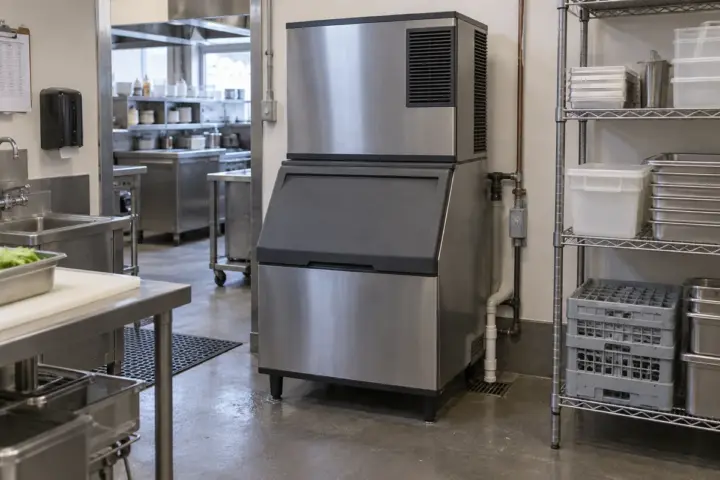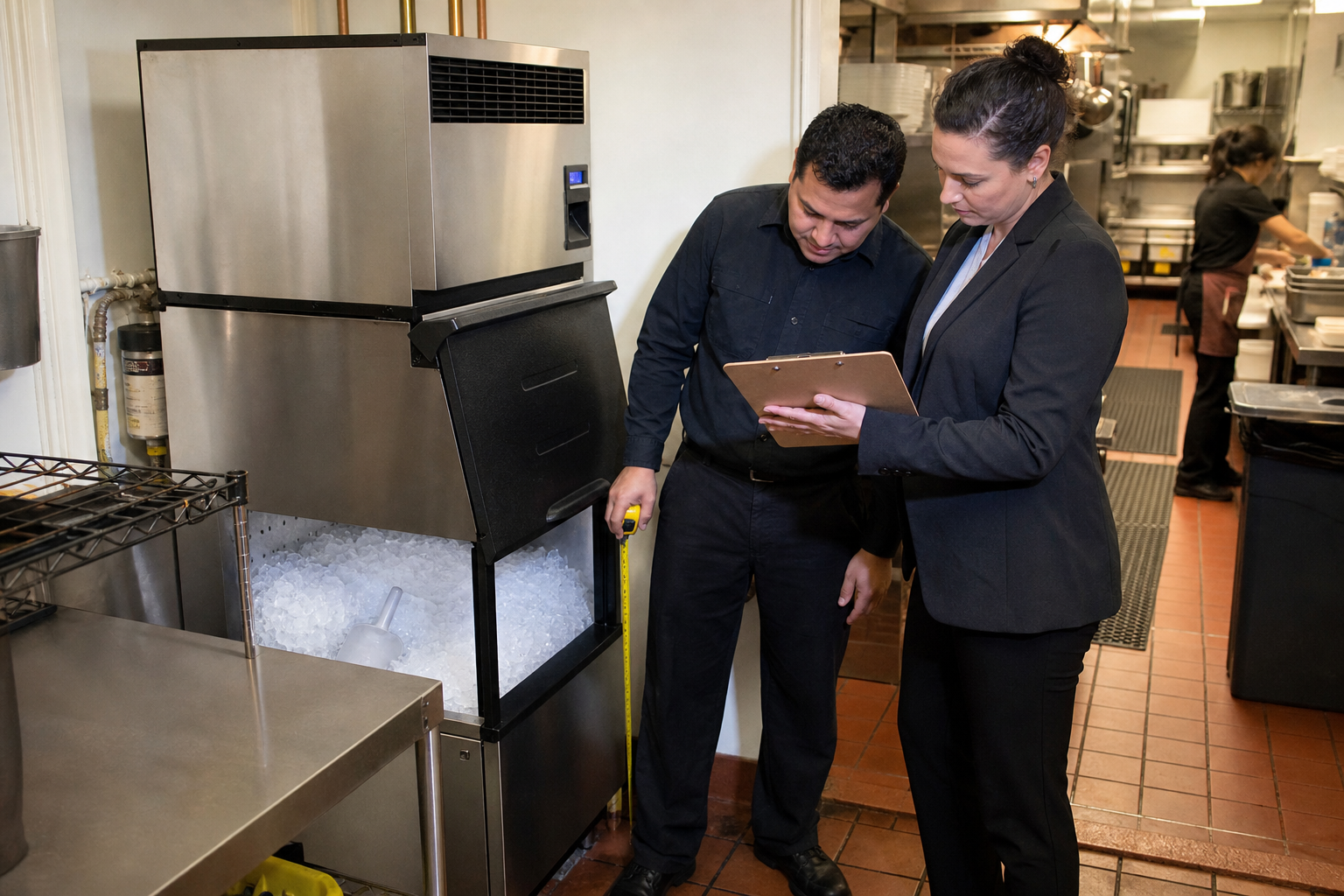
Commercial ice machine sizing looks simple when it is reduced to pounds per day. In practice, the right system has to cover a business’s busiest operating window, recover after heavy draws, and fit the space and utilities available. A machine that produces enough ice across 24 hours can still leave a restaurant short at 7:00 p.m. if the storage bin and recovery pattern were never considered.
The most reliable starting point is to separate three questions: how much ice the operation uses in a normal day, how quickly that ice is taken from the bin, and how much production margin is needed for heat, water conditions and unusually busy periods. Freezer Supply’s commercial ice machine overview groups equipment from compact undercounter machines through modular systems producing 1,500 pounds or more per day, but production rating alone is not the final selection.
Start with actual ice use, not a generic rule
Industry rules of thumb are useful for a first conversation, but actual operating records are better. A restaurant should look at beverage count, bar demand, kitchen use, catering volume and any ice used to hold food cold. A hotel must separate lobby or banquet use from guest-floor demand. Healthcare facilities may need dependable nugget ice at several stations rather than one large central bin.
When records exist, review at least several busy weeks rather than a quiet average. If records do not exist, count seats, transactions or occupied rooms and document where ice is used. Our practical capacity FAQ explains the basic sizing inputs, while the restaurant sizing guide is a useful companion for foodservice operators.
Daily production and peak demand are different numbers
A machine rated for 700 pounds per day does not necessarily make 29 pounds every hour in the conditions found at the jobsite. Published production is measured under specific air and incoming-water temperatures. A hot kitchen, warmer supply water, scale buildup or restricted airflow can reduce actual output.
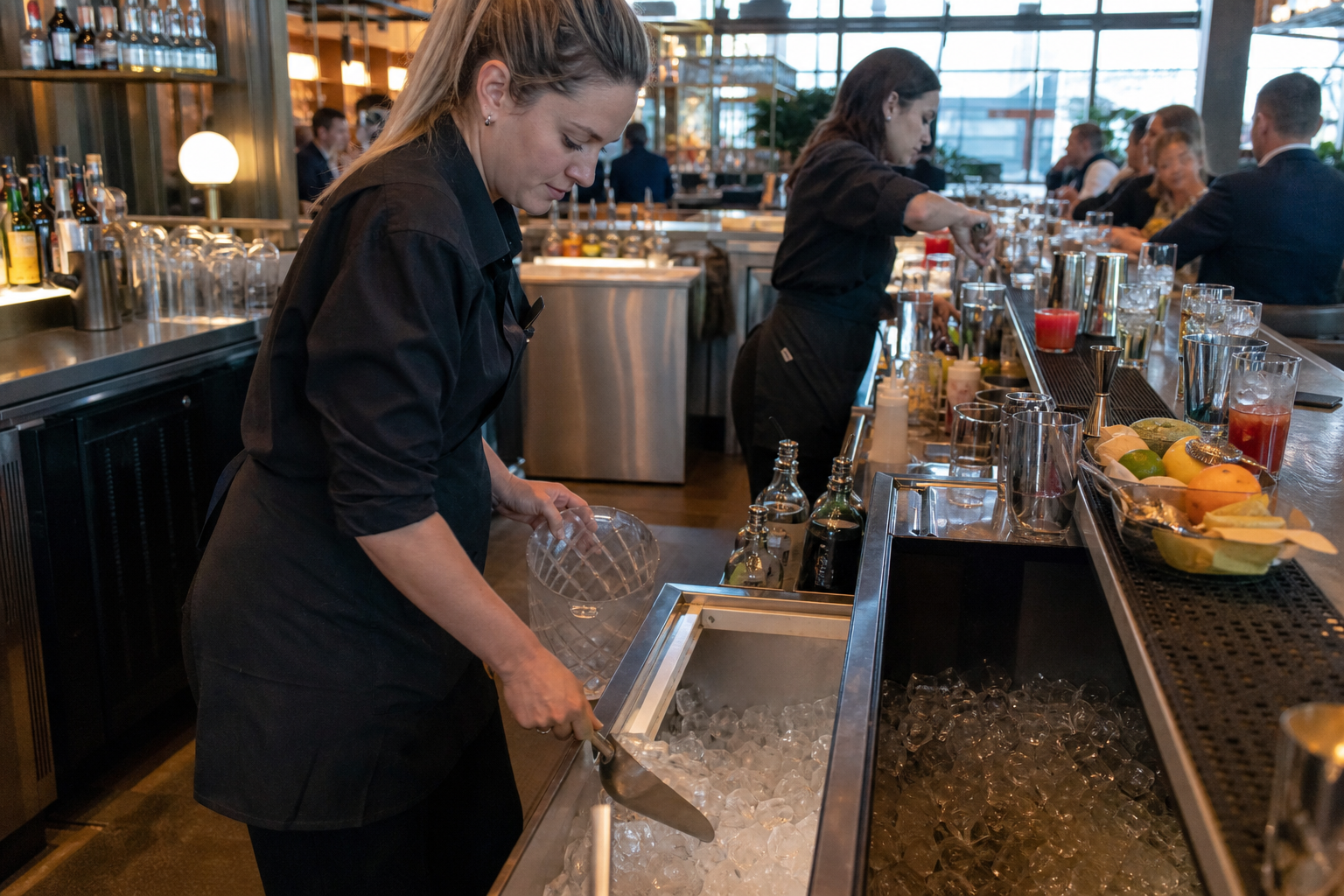
Peak demand asks a different question: how many pounds may leave the bin in the busiest two or three hours? A bar can consume a large share of its daily ice between happy hour and dinner. If the bin begins that period half full, the operation may run short even though the machine catches up overnight. This is why storage and recovery have to be planned together.
Choose storage capacity around the operating cycle
The bin is a working reserve, not simply a base for the ice head. Its useful capacity should cover heavy withdrawals without encouraging unnecessary ice age or creating a bin that staff cannot reach and clean comfortably.
- Steady demand: A facility that draws ice evenly can often use moderate storage because production and use occur together.
- Concentrated demand: Restaurants, bars and banquet operations generally need more reserve for defined rush periods.
- Limited overnight production: Noise restrictions, maintenance routines or shut-down periods change how much ice must be stored before service.
- Sanitation and access: A larger bin is not an advantage if staff cannot rotate ice, reach interior surfaces or follow the cleaning schedule.
The detailed Freezer Supply article on choosing ice-bin storage capacity covers the storage side of the calculation.
Apply a realistic production margin
Good sizing includes margin, but not an arbitrary oversize. Additional capacity protects against warmer conditions, seasonal traffic, cleaning downtime and normal business growth. Too much excess capacity can create its own problems: higher purchase cost, more space, larger utility requirements and ice that sits in storage longer than it should.
For a growing operation, it is often smarter to plan the room, utilities and condenser strategy for future capacity while installing the machine that fits current demand. In a high-consequence facility, redundancy may be more valuable than one oversized machine. Two appropriately selected units can preserve partial production during cleaning or service.
Confirm the site can support the selected machine
Before equipment is ordered, confirm the water supply, filtration, drain, electrical service, heat rejection and service clearances. A larger air-cooled head may not perform well in a tight, hot alcove. A remote condenser can move heat and noise away from the workspace, but it adds installation requirements. The final selection should be reviewed against the commercial ice machine pricing form with the real production and site details attached.
Frequently asked questions
Should an ice machine be sized to the busiest day of the year?
Usually not by itself. Size around a documented busy operating pattern, then decide how rare peaks will be handled. A reasonable reserve, temporary supplemental ice or planned redundancy may be more economical than buying around one exceptional event.
Can a larger storage bin make up for an undersized ice maker?
Only to a point. A larger bin can bridge a short peak if the machine has enough time to refill it. It cannot solve a persistent daily production deficit.
Why does actual production differ from the published rating?
Production changes with incoming-water temperature, surrounding-air temperature, condenser condition, scale, airflow and maintenance. Published specifications should be adjusted for the conditions expected at the installation.
Is one large machine better than two smaller machines?
Not always. One machine may be simpler and take less total space. Two machines can provide staged capacity and partial redundancy, which matters where an interruption would be expensive.